

How to play
Kazinga rules & scoring
A minute to learn. Considerably longer to stop talking about. Two dice tell you how many Kazinga Koins move and which way. You choose the colors, you choose the target, and you live with the results. Then somebody plays a Wildcard and the whole plan takes a left turn.
- The object
- First to hold all twelve Koins of one color
- A turn
- Roll both dice. Move that many Koins, in that direction.
- Wildcards
- Eighteen of them, playable almost any moment
- Players
- 2 to 6, ages 7 to 99 and up
The rulebook in the box is the authority. If this page and the rulebook disagree, the rulebook wins.
Setting up
Four things to do, and one of them is optional.
- 1
Deal the Koins by player count
Every player gets the same number of each of the six colors, and how many depends on how many of you there are. Six of each color at two players, down to two of each at five or six. Fewer players, more Koins each; more players, fewer.
- 2
Deal three Wildcards each, if you want them
This is optional. Wildcards are what makes Kazinga Kazinga, so leaving them out gives you a quieter and considerably duller game — but the plain version works, and it is a reasonable way to teach somebody the dice before teaching them the treachery.
- 3
Leave the center stash empty
The stash is a shared pile in the middle of the table. It starts with nothing in it. Some rolls put Koins there, some rolls take them back out, and one Wildcard raids it.
- 4
Decide who goes first
In the printed rules, the youngest player rolls first. The app flips a Koin instead — it has no way of knowing who the youngest player is, and it does not ask. After the first roll, play passes in order round the table.
A turn, in three parts
Roll, read, decide. The third part is the game.
1. Roll both dice together
The two dice do different jobs, and neither is much use without the other.
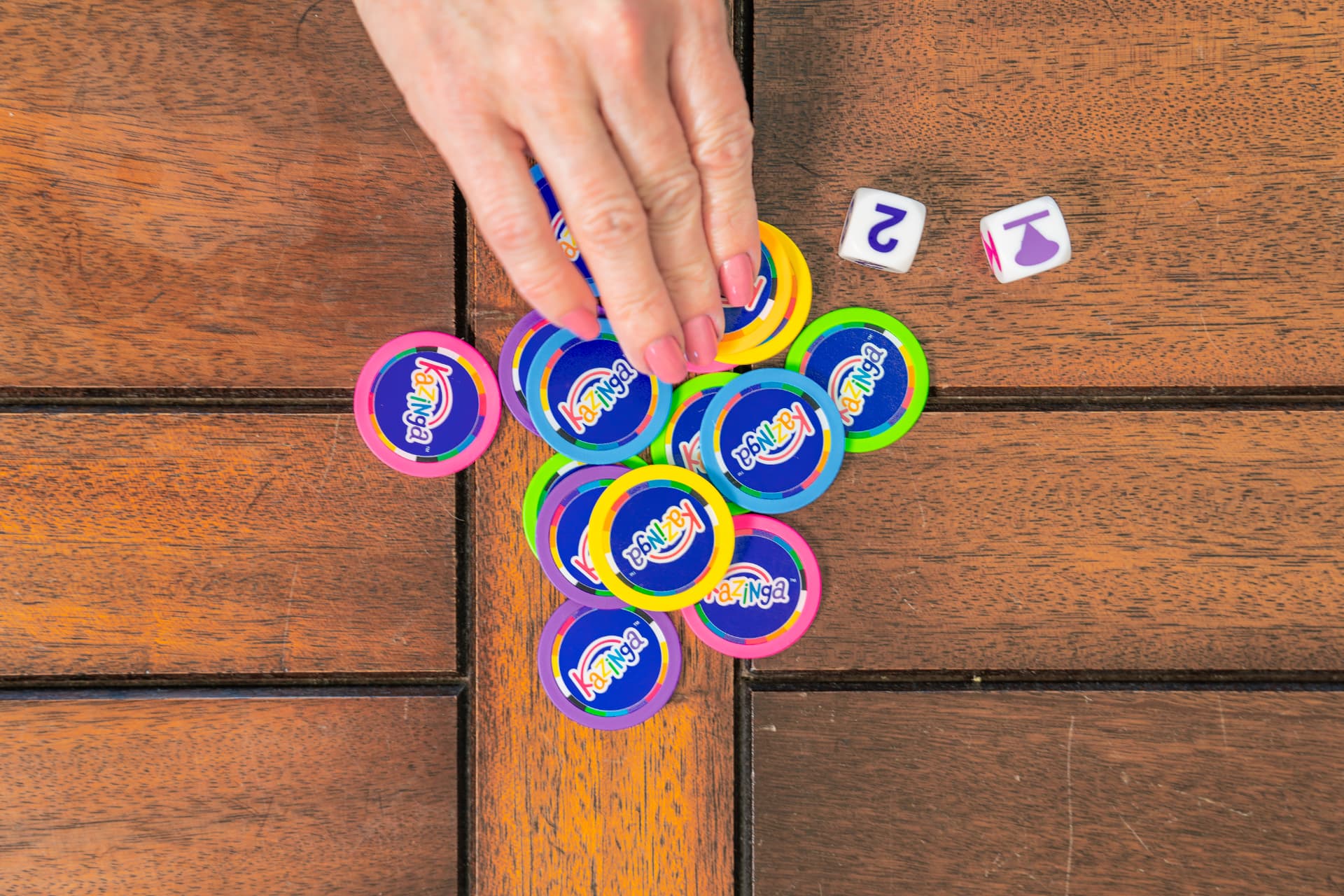
The number die reads 1, 2, 2, 2, 2, 3. It decides how many Koins move. Four of its six faces show a 2, so most turns move exactly two Koins — a 1 or a 3 is the exception rather than the rule, and the game is built around that.
The direction die decides where they go. Six faces, and only two of them let you choose your target.
| The direction die | What it decides |
|---|---|
| Give to the player on your left | One recipient, no choice about who. |
| Give to the player on your right | The same thing, in the other direction. |
| Give to another player or players | You choose who — and you may split the Koins between more than one of them. |
| Take from another player or players | You choose who, and you may take from more than one. |
| Give to the center stash | Out of play, and out of everybody's reach until somebody rolls to take from it. |
| Take from the center stash | Whatever is sitting in the middle is yours to pick from. |
2. Move that many Koins
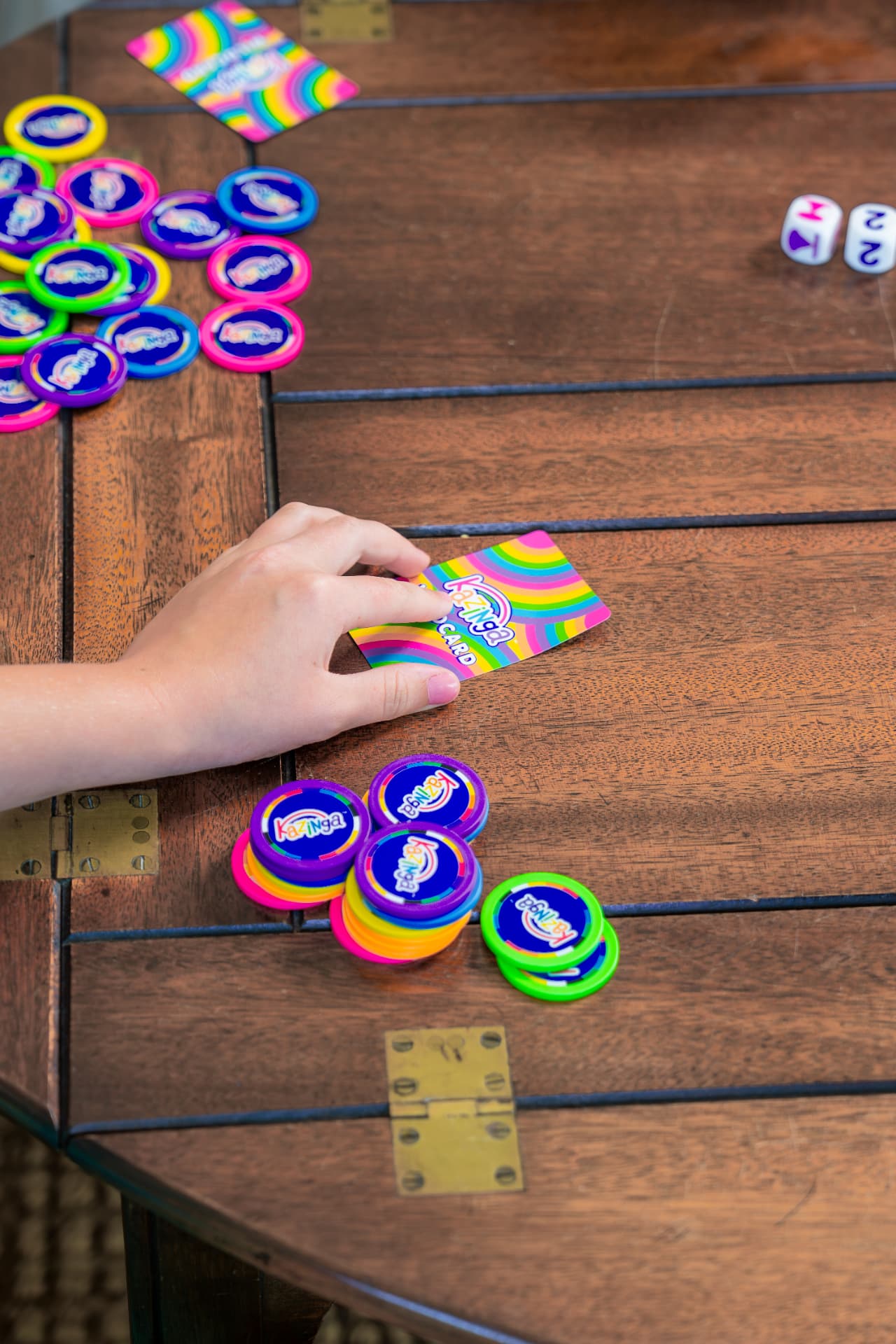
Move the number the die showed, in any combination of colors you like. Two of the same color, or one of each, or on a three-roll any mix of three. The dice set how many Koins move and which way they travel — never which colors, and never which piles. Whoever is resolving the dice, or a Wildcard, chooses the colors and chooses the piles: from your own stack, from another player's, or to and from the center stash. Nobody can make you hand over a particular color.
3. Decide who it hurts
On the two “another player or players” faces you pick the target, and you may spread the Koins across several people rather than dumping them all on one. This is where most of the game's arguments start, and it is the whole reason the game works with six people who know each other well.
The eighteen Wildcards
Seven kinds. Deal three to each player at the start, and hold them until the moment they will do the most damage.
| Card | How many | What it does |
|---|---|---|
| Trade 2 Koins | 3 | Trade two of your Koins, any color mix, for two of another player's, any color mix. You give up two and receive two back. |
| Steal 2 Koins | 3 | Take two Koins of any color or colors from another player. |
| Donate 2 Koins | 3 | Give two Koins of any color or colors to another player. Rarely generous. |
| Raid the Stash | 3 | Take two Koins of your choice from the center stash. |
| Intercept | 3 | Redirect the Koins that were just moved to yourself instead. |
| Take the Dice | 2 | You roll next, out of turn order. |
| Kazinga Zinger | 1 | Trade all of one color of yours for all of one color of another player's — and it cancels every remaining Wildcard for the rest of the round. There is exactly one of these. |
When you may play one
- Not until everybody has had at least one roll. No ambushing somebody who has not started.
- Shout “Kazinga!” and play the card before the next roll. The shout is not decoration; it is how the table knows to stop.
- You cannot play one once it is about to become your own turn to roll. Any other moment is fair game, including the middle of somebody else's good idea. In a two-player game this restriction does not apply at all.
- If several people play at once, resolve them clockwise from the roller's left.
- Nothing can be played after somebody has already won the round. A win is final.
Winning
In the standard game — Just-the-Basics — you win by being first to capture all twelve Koins of a single color. At a five-player table it is ten, because the Koins are spread differently.
The round ends the instant it happens, and no Wildcard can steal the win away. That matters more than it sounds: it means the last Koin is genuinely the last Koin, and nobody gets to undo a finish by shouting.
Play a single round, or string rounds together into a tournament and keep score across them.
The six Game Styles
Same Koins, same dice, same Wildcards, entirely different problem to solve. All of them are described in the rulebook in the box.
The standard game
Just-the-Basics
Capture all twelve Koins of any single color — ten at five players. The straightforward race, and the one to learn first.
Harder finish
A Perfect Game
Capture all of one color and hold no other Koins at all. The same finish line as Basics, except you also have to shed everything else on the way there.
Everyone at once
Pro-Mode
Each player is assigned their own color before play starts, and nobody else's Koins of that color count toward your win. Six people racing toward six different finish lines.
Backwards
Hot Potatoes
The opposite of every other style. Pick two colors and race to shed all of both. Everyone must roll at least once before anyone can win.
Two against two
Teamwork (Makes the Scheme Work)
Hardwired two versus two. You and your ally chase two shared colors and win by holding all of both between you. Split it one color each for a Neat Win, which is harder and rather more satisfying.
Everyone against one
The Dogpile
You are the target. Everyone else is trying to bury you in one color while you try to shed it to nothing. Two more colors are in play as decoys and the rest sit out. Your attackers get three Wildcards each; you get one.
You're So Sneaky is a seventh style, and it exists only at the table. You commit to a color and say nothing about which one, and that depends on people sitting round a shared table reading each other. It does not survive a screen, so it was never built into the app and never will be.
Where the app differs from the box
They are not the same product and we would rather list the differences than let you find them.
- Who goes first. The printed rules say the youngest player. The app flips a Koin, because the youngest player is exactly the thing an app cannot know — and it will not ask anybody's age to find out.
- The Dogpile's colors. At the table, which colors are in play and which one is the target are yours to choose. In the app they are set for you, which is the sensible thing for a game you can start in one tap.
- You're So Sneaky is in the box only, permanently. You commit to a color and say nothing about which one, and that depends on people sitting round a shared table reading each other. It does not survive a screen.
- Computer opponents are in the app only, at four levels — Easy Breezy, Friendly, Bring It On and No Mercy. A box cannot bluff you.
- Three styles in the app, three more in the Expansion Pack. The app comes with Just-the-Basics, Pro-Mode and A Perfect Game. Teamwork, Hot Potatoes and The Dogpile are a separate purchase and are not included in the app.
Table talk
Still wondering
- How long does a round take?
- It depends on the style, the number of players and how freely people spend their Wildcards — a Basics round with two cautious players is nothing like a six-player Dogpile.
- Can we play without the Wildcards?
- Yes. Dealing them is optional and the dice game underneath works on its own. It is a good way to teach a new player, and a poor way to spend an evening.
- Do I have to give up the color somebody asks for?
- No. When you move Koins you choose the colors, every time. The dice tell you how many move and which way they travel — never which color, and never which pile. Whoever is resolving the dice or a Wildcard picks the colors and the piles, whether that is their own stack, another player's, or the center stash.
Share this page
Tap the button to copy a link and share it with anyone you like. We never collect names, emails, or any personal information.